VIKING AGE IN RIBE, DENMARK
Ribe is the best place in which to experience the Viking Age as it took place in Denmark. Ribe is Denmark’s and Scandinavia’s oldest town.
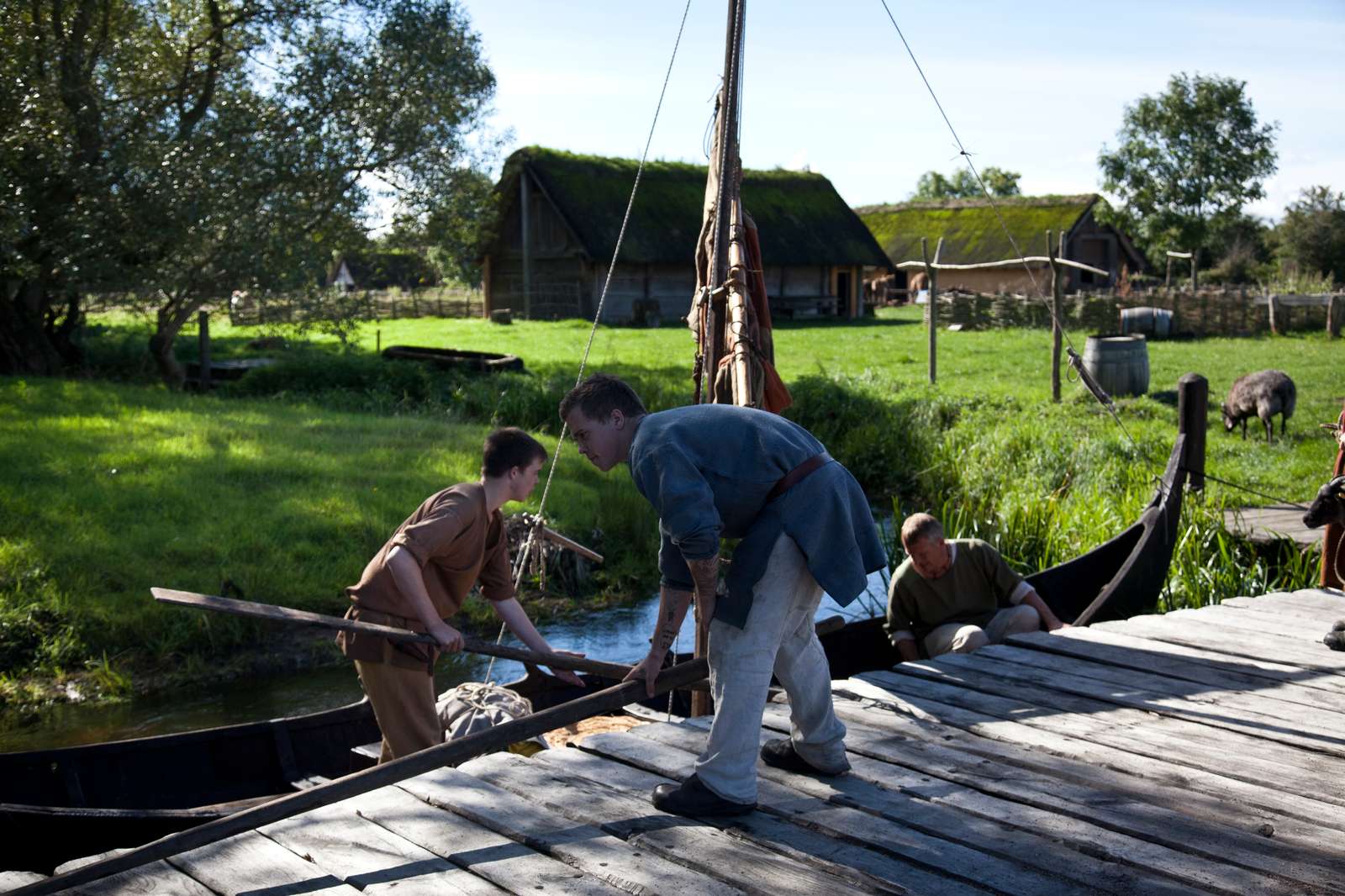
Here in Ribe you can both see authentic Viking findings, experience the reconstructed Viking Age and learn through hands-on activities.


Viking attractions and sites in Ribe:
- Ribe Viking Museum (Museet Ribes Vikinger)
- Ribe Viking Centre (Ribe VikingeCenter) – Reconstructed, full-size Viking environments and hands-on activities
- Ribe Viking Market (Ribe Vikingemarked). Denmark’s most authentic Viking Market a week around May 1st. Ribe Viking Market is a Top Event in Denmark
- A Viking Walk in Ribe. You can book a guide at the Museum Ribes Vikinger, who will guide you around Ribe and tell you what life was like in Viking Ribe
- Free self-guided Viking Walk in Ribe. Use Danhostel Ribe’s self-guided Viking Walk below to guide your way around the former Viking town of Ribe
Read about these places: Museums and Activity Centres

Viking Age started in Ribe – the first Viking town in Scandinavia
In the early 700s a market place was founded at Ribe River (700-710 AD). The market place was the beginning of Ribe – Denmark’s and Scandinavia’s first city and soon the largest trading centre of the Nordic countries. Ribe was a bridge between worlds and an international metropolis. Recent studies of Viking findings from Ribe have shown that Viking ships brought reindeer antlers from Norway to Ribe for the comb maker’s workshop. These commercial trips between Norway and Denmark allowed the Vikings to develop the maritime skills and geographical knowledge they needed for their future raids. This have now made 3 archaeologists say that the Viking Age started in the early 700s in Ribe and not in 793 when Vikings attacked the Lindisfarne monastery in northern England, since seafaring and long sea voyages are central to decide when the Viking Age started. (Viking Age until now ca. 800-1100).
History TV, Vikings: Ribe is a Viking Age must-know
You can’t understand the Viking Age without knowing Ribe. Learn more in this episode of “Secrets of the Vikings” from “Vikings” – season 3, 2015 (History Channel)
Lonely Planet: Vikings in Denmark
“Viking Denmark” was picked as number 5 on the list of “Lonely Planet’s Best in Europe 2014“. They say: “Why not settle in Ribe, Denmark’s oldest town (founded around 700 as a Viking market place), recently voted ‘Europe’s Best Big-Time Small Destination’”
Read more: Lonely Planet’s travel tips in Viking Denmark
“Enjoy” our little Viking video with the wise Woman, völva, from Ribe VikingeCenter. She is telling some of the hostel’s guests why she sacrificed a horse to the gods.
VIKING WALK – RIBE IN THE VIKING AGE
This walk will take you to all of the most important places in Ribe’s Viking history and tell you about the everyday life in Ribe at the time.
NOTICE: There are no longer any visible buildings left from the Viking age. However, in the historical walk “Old Town Walk” through medieval and renaissance Ribe, you can still see many of the buildings – so maybe you will prefer that walk: Old Town Walk.
The numbers in the text refer to the numbers on the city map
The green line (6) refers to Ribe Town ditch and a smaller rampart – the light brown line refers to the later fortification
1. and 2. Sct. Nicolai Gade. Denmark’s first pedestrian street.
From Danhostel Ribe (1) you walk up Sct Peders Gade and turn right. Instead of continuing across the small river, which would bring you to the pedestrian street and the Middle Age part of Ribe, you turn left on Sct Nicolaj Gade (2).
On this side of the river (Map: North of the River) you are in Ribe as it was defined in the Viking age. At the time, Ribe was almost only situated on this northern side of the Ribe river. (Except from 11 and 12 on the drawing).
Underneath Sct Nicolaj Gade you will find Ribe’s (and Denmark’s) first pedestrian street. 1300 years ago, visitors and inhabitants of Ribe would go here to buy daily necessities such as food and clothes, but also luxury goods such as jewellery and knives.
Most of the street proceeded in the same way in the Viking age as it does now. The leftovers of the plank path is still a couple of meters underneath the present street. The market place was situated on both sides of the street (approximately the stippled area on the map). Fences made out of willow branches and small ditches were used to separate the individual workshops and trade stands on pieces of land that were approximately 7 meters wide. The ditches were also used to derive rainwater and garbage.
Mark that the street is elevated – this is because 2-3 meters of garbage from the workshops, the houses and the fireplaces is covering the street. Imagine smells, sounds and visions when walking into the market. The market was filled with people with different skin colours and clothing. The goods you would admire were also new and strange. Many languages and smells from freshly baked bread, soup, fried meat and strange spices filled the air. But you would also sense the smell of animals and their excrements and smoke from the metalworker’s forge. The sounds from squeaking wheels and the blacksmith’s hammer accompanied the sounds of the musicians’ instruments, the buzzing of the flies and the play of children.

3. Sct Nicolaj Gade by Ribe Art Museum. Ribe’s birth certificate and the Viking’s houses
Continue up the street and stop by the little square in front of Ribe Art Museum (3). Some of the findings made here were 1,5 meters of cow excrements from the 700s and the remains of a well. Dendrochronology (Tree ring dating) of the wood in this well’s reveals Ribe’s birth to be in the first decade of the 700s (therefore it is called Ribe’s birth certificate).
Behind the square were also found remains of Viking houses. It was small well built houses, suitable for craftsmen and pithouses for workshops that were partly excavated into the earth. The houses hardly had room for animals. Archaeologists assume that these houses were lived in when the market place was established.
Between 3 and 4. In the museum garden. Viking market place and harbour
Cross the street. Between the art museum and the post office you will find a small path. Take this path and enter the museum garden through the gateway in the Danish artist Per Kirkeby’s wall. Continue through the garden towards the small river.
The original harbour, which belonged to the market place, must have been somewhere in the middle of the river, but it has not been found yet.
It was well chosen to place Ribe, Denmark’s first town here. Imagine that the river at the time was much broader and had much more water in it than it does today. The ships could sail from Ribe through the Wadden Sea to England, Frisia (the Wadden Sea coast south of Denmark), the Frankish Kingdom and even further away. They could also sail into many places in Denmark through the river’s many smaller streams.
A lot of the traffic in the Viking age took place via water, as the landscape in the Jutland peninsula was difficult to cross. At the time there were no ships, which could sail north of the peninsula to the eastern part of Denmark, which is why Ribe became a centre for goods going into the rest of the world through west as well as into the rest of Denmark and Scandinavia through east.
There was however one other way to transport goods eastwards: A trail went from Ribe across the country to Kolding and Haderslev, 2 towns on the east coast of the Jutland peninsula .
When it comes to north/south traffic, Ribe was also very well situated. Ever since ancient times there had been a trail all along Jutland’s coast (the later North Sea Trail). This trail had to pass many rivers and was thus twisted and turned to fit all the best crossing points. There was such a crossing point by the market place in Ribe, where the north/south trail also crossed the eastern trail from Kolding and Haderslev.
Underneath Ribe Art Museum and in the museum’s garden several findings from the Vikings’ market place have been found.
Foreign merchants came sailing up the river to sell glass, jewellery, wine, ceramics, grinding stones to grind grain into flour and more.
The Danes sold amber. There must have been plenty of it at the time. More than 6 kilos of small and big pieces of amber have been found in the layers of garbage derived from the market place. In the amber workshop was small gaming pieces and beads produced. Often the beads would break when trying to drill holes into them.


Large amounts of manure and bones indicate that prepared food as well as sheep and cattle were sold here. Besides from this, it has been difficult to figure out what the Danes would sell. Although they probably sold wood and fur, these products have not left any traces.
A new theory on this is that the Danes possibly sold slaves. One of the reasons for Ribe’s emergence at this time can be linked to the fact that the Franks had forced the population near the River Rhine south of Denmark to become Christians in the beginning of the 700s. Since Christians could not hold Christian slaves, it is possible that they sought further north towards Ribe to purchase pagan slaves.
The comb maker at Ribe Viking market made combs of reindeer antlers saild to the market in Ribe from Norway by Viking ships
Craftsmen were of course attracted to the market place. Here they had good possibilities to sell their goods, and when there were not too many customers, they would also produce new goods here. Traces from different crafts such as blacksmith, metalworkers, shoemakers, amber cutters, comb makers and glass beadmakers have been found. The garbage from the workshops are from clothes, leather, glass, amber, bronze, bone and horn.
The goods were either exchanged or bought for silver coins. The market place soon generated a Danish coin economy to replace the foreign one. A lot of coins have been found on the market place, especially some small silver coins (Sceattas). It is assumed that these were minted in Ribe. They are called Wodan/monster coins – although neither Odin nor a monster was stroked on the coin. Instead, it had a mask with a beard and hair on the one side and an animal on the other.
Maybe a magnate or a king founded the market place. We know that the oldest part of the Danish fortification Dannevirke is from 736, which indicates that there has been a central power already at the time. It can also be Frisian merchants, who founded the town. The Frisians ruled the Wadden Sea coast south of Denmark, and already at the time they had founded several trade cities along the coast south of the Danish boarder. The most likely is probably that it was a cooperation, where the Frisians founded the market place with the permission from the king or magnate, who in return assured peace, organization and preparation of the market place for every season. In return he would receive incomes from taxes, rent and currencies.
Walk back to Sct. Nicolaj Gade.

4. The glass beadmaker’s workshop
Just before you enter Sct Nicolaj Street again you will find the post office on your right hand. Go to the glass display case at the gable. Here you will find a reconstruction of a glass beadmaker’s workshop from the Viking Age. Excavations from underneath the post office revealed remains from a glass beadmaker’s workshop.
You will also find an authentic cut through all the layers of the Viking market place in Ribe. At the bottom – approximately 3 meters under today’s street surface – you see the ground of that field, on which the market place was founded around year 705. The first years the Vikings did not use their market place during wintertime. Every season it was prepared for the next year, often by spreading a layer of sand out on the ground. Not until around year 800 houses were added to the market place in order to use it all year around. Hundreds of thin layers of earth are spread out and consists of garbage, floors, fireplaces and remains of houses. The white areas you see are leftovers from fireplaces filled with ashes.
When archeologists explore an area, they separate the different layers of earth in order to trace the development from year to year. In this way they have revealed that it was not always the same craftsmen, who used the market place from year to year. This indicates that they did not own the land, but rented it for a season. The archaeologists have also been able to trace the changing in fashion – here the beads are a good indicator. Whereas the first year’s market had beads which were quite colourless, they eventually developed into very colourful beads when the import of blue glass and colorful mosaic stones from Northern Italy began (you can see both kinds in the Viking Museum (Ribes Vikinger).
Beadmaker’s workshop at Ribe VikingeCenter
5. Ribes Vikinger (Ribe’s Vikings) – Museum of Viking Age and Middle Age
Continue up Sct. Nicolaj Street to Odins Plads. The museum Ribes Vikinger (Ribe’s Vikings) is situated on Odins Plads. A 4 cm tall mask figurine in lead found in Ribe depicting the Norse god Odin (Woden) with the two ravens Hugin (“Thought”) and Munin (“Memory”) perched on his shoulders has become the logo of Ribes Vikinger (the Viking Museum). The lead mask was a sort of mother mould to produce new figurines. By pressing the lead mask into soft clay the founder could produce many moulds, which he could use to produce jewellery, keys, buckles and other things by pouring the liquid metal into the mould. The clay mould could only be used one time, as you had to break it in order to free the finished object. The Odin figurine was produced as a bronze jewellery. (You can see the founder’s workshop in the experience room at the museum, which also houses more moulds and objects.)
ven when the museum was built in 1993, many findings were revealed from the Viking Age. The The archaeologists also found remains from an old castle foundation. Around the approximately 6000 m2 big castle foundation was a turf rampart. Archaeologists suppose that the castle was founded in the 1100s to defend a bridge over the Ribe Å (River). The castle was made superfluous in the 1200s when a dam was built across the Ribe river. Today, this damn is Ribe’s pedestrian street: Overdammen, Mellemdammen and Nederdammen. Read more about this under: Ribe Old Town Walk
6. Heathen burials. Ribe is fortified in the 8-900s. Town ditch and earthwork
Continue over Odins Square and cross the railway line to Tangevej. Go up on the rampart with the water tower on your right hand (the Ribelund-area).
The first town ditch around Ribe was build here in the first half of the 800s (more or less equal to the green line on the drawing). It was 2-3 meters wide with a small rampart on the inside. It did not have any water in it. The limited town area was about 100.000 square metres. Such a ditch was not able to stop attacks from enemies, and therefore it must rather have been a sort of town boundary. The boundary probably also marked where the town’s laws, rights and duties were upheld. The market peace was guaranteed by the king, and the king’s men controlled the merchants and their goods before they entered the city. The merchants paid a tax in return. The ditch is only known in the town’s eastern part (the area in which you are standing now), but it is assumed that it went in a half circle around the city and ended by the river, almost where Danhostel Ribe is now situated.
In the 900s the ditch was replaced by a one meter deep and eight meter wide moat. Besides from this there was a rampart made out of turf – and perhaps a palisade on top of it to protect the guards. This moat almost had the same course as the former ditch had, and is also only known in the eastern part.
This area on Ribelund is also where the southern part of the heathen Viking burial place has been found. The Viking burial place will be further elaborated in section 10.
(You can choose to stop here, read section 7 and 8 and continue your walk by number 9)
7. Ribe is expanded and further fortified in the 1000s and 1100s.
Continue down the path on the other side of the rampart until you reach the first house on the Ribelund area on Kastanie Alle.
The city of Ribe was expanded in the Middle Ages (in the 1000s and 1100s). At the time an even bigger fortification was built, which ran underneath the house, which you are standing next to right now (see the brown line on the drawing).
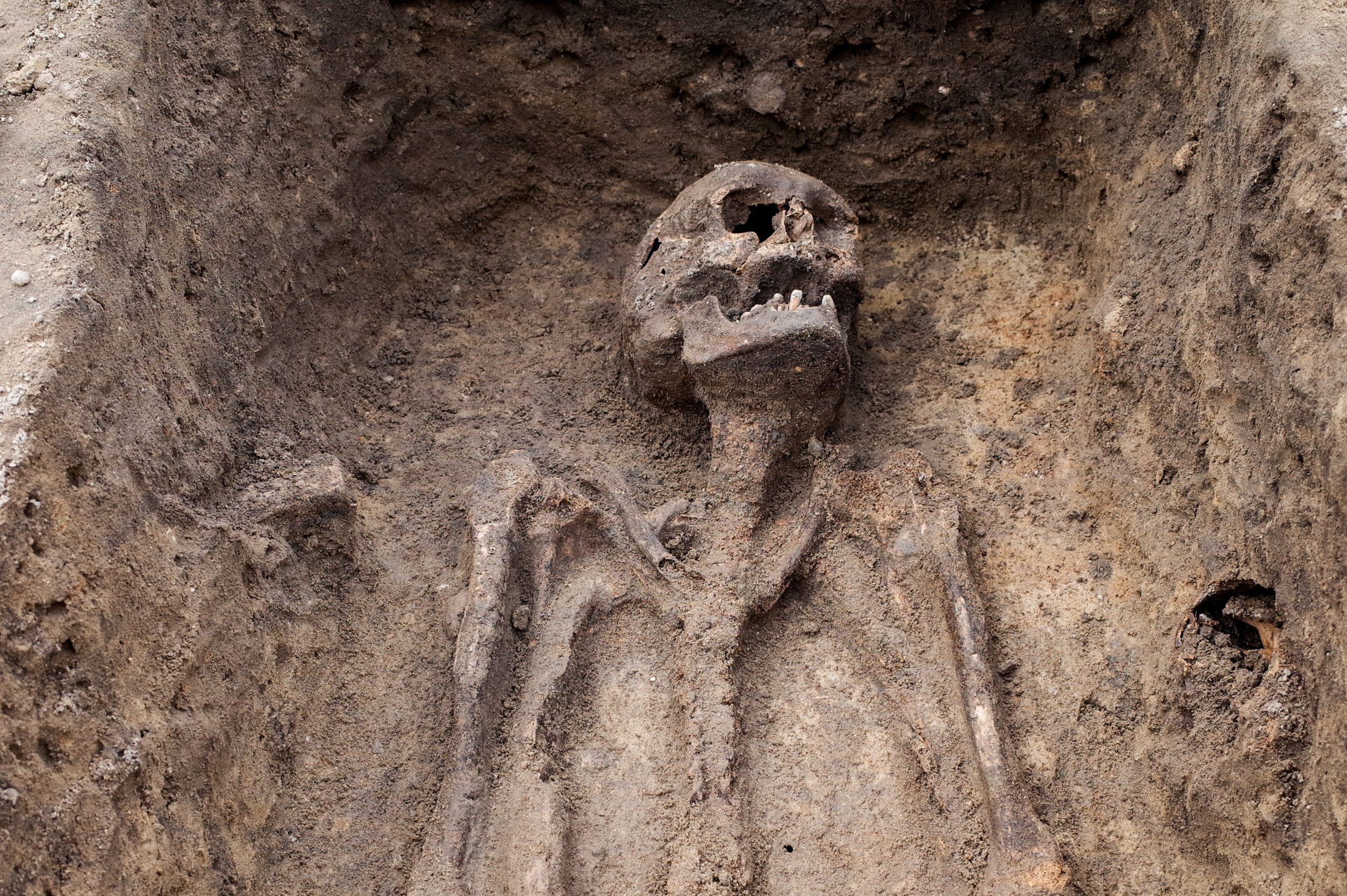
Continue along Kastanie Allé. On your right you will pass some bird aviaries. Around here, 14 Christian burial places from around 900 were found. You can recognize a Christian burial place by how the body is buried. No presents and that the bodies were placed east/west, so the dead person’s feet would turn eastwards and the head westwards will indicate a Christian burial. The east/west placement meant that the dead on the day of resurrection would look eastwards, where Christ would reveal himself. By the interment of a Christian Viking the body was placed unburnt in the ground, perhaps placed on a piece of cloth or leather or placed in a coffin. More about Christian burials under section 11 and 12.

8. The Viking houses
On your right hand, before Kastanie Allé turns left, you will see some greenhouses. Here the archaeologists found remains of settlements, which were lived in around the time of the foundation of the market place. The wooden Viking houses that once were here were varied in sizes – some up to 25-30 meters long, some small partly excavated workshops (pithouses). A road, a fence and a well were also found. Many of the houses had room for animals and stock of goods to be sold on the market. This means that these houses were bigger than the ones previously found at the market place.
9. Rosen Allé – burial place.
Go back to Tangevej and cross the railway line again. Turn right and walk along the railway via Rosen Allé to Seminarievej. On your right hand – all along Rosen Allé to Seminarievej – is a burial place from the 700s. There has only been made excavations in certain areas. Around 30 graves have been found in the area and only heathens were buried here. When you reach Seminarievej, turn right.
10. Seminarievej. Pagan burials
Just before the level on Seminarievej, take the staircase that leads to the parking lot. Around 400 graves from the 700s have been found here. Of these were two inhumation graves while the rest were cremation graves. Pagans were buried both in cremation graves and in inhumation graves. In the cremation graves the ashes from the dead was placed in a small hole in the ground or in an urn. Only few of the cremation graves contain other than remains from the fireplaces and burned bones, but in the few urn burials which were found, there were also gifts such as combs, equestrian equipment, keys, knifes, glass pearls and more. If the gifts were too large they were placed beside the urn.
A girl with a bead necklace has been found in one of the inhumation graves. The same kind of beads could be purchased at the market in Ribe around the end of the 700s. The girl is buried on her right side in a sleeping position in a inhumation grave. Perhaps she was placed on a piece of leather.
Remains of a horse from a horse sacrifice were found in the middle of the burial ground. This indicates that the burial place was founded with a sacrifice to the Norse gods.
Traces of both the early and the later town trench have been found on the burial ground (see section 7). Across the paved parking lot, the previous town trench from the 800s is marked with a line of bricks.
In 2012, excavations near the supermarket Netto on the other side of the street revealed more graves. This is the most northern part of the pagan burial place as far as we know. When you were in section 6, you were at the most southern part.

11. and 12. News that changed the Danish history and the Viking Age history in Ribe
Viking Age Christian Church and Christian funerals at Ribe Cathedral
The Viking walk was supposed to stop here, but from 2008-2012, the archaeologists during excavations just south of Ribe Cathedral (12) found 82 of the first Christian burials in Denmark in a cemetery, which operated from approx. 850 AD to approx. 1050 AD. The deceased was buried east / west in a variety of coffin types.
Based on test excavations the archaeologists have no doubt that this Christian cemetery has been all the way around the current Ribe Cathedral, that it was bounded by ditches and probably contains up to 2000-3000 Christian Viking graves.
This is the first time there’s been findings from the Viking Age in what we usually call Ribe’s medieval town (south of the river).
The finding of this Christian cemetery changes Denmark’s history . It was not the Danish king Harald Blåtand (Harold Bluetooth), who Christianized Denmark in the mid 900s, as he proclaimed on a – now UNESCO World Heritage – runic stone in Jelling, at the time the Christians had already lived a hundred years side by side with pagans on the international market place in the Vikings’ Ribe. (Read more)
Around the year 860 was the monk Ansgar by the Danish king allowed to establish the first Christian church in Denmark in Ribe. Archaeologists now believe that it is most likely that Ansgar’s Church was below the current Ribe Cathedral (11). The findings of the Christian graves have now supported the written sources on Ansgar’s mission in Ribe around 860 and the creation of Ribe bishopric in 948, where it is said that the first bishop of Ribe, Leofdag, was killed by the wild pagans, when he tried to escape from them over the Ribe River. He had probably been visiting the market place on the other side of the river to preach for some believers of Norse paganism.