
Storm surges and floods in Ribe and the Wadden Sea National Park in Denmark
At Skibbroen, Ribe’s harbor, facing Danhostel Ribe you’ll find a storm surge pole (Stormflodssøjlen). The pole is marked with metal rings showing the water level at the many storm surges that, through time, have flooded Ribe. When you look at it and see how high the seawater at some times was in Ribe’s streets, you will understand why the citizens of Ribe fear storm surges and The North Sea. At regular intervals, the marshes have been flooded and houses and roads destroyed. Again and again, people and cattle have had to take refuge at more elevated grounds in order to save their lives.

The upper ring of the storm surge pillar– 6.10 metre (20 feet) past the normal water level – is marking how the water in 1634 rose more than 6 meters above normal and washed away several farms and drowned thousands of people in the Wadden Sea area.
Sea View rooms at Danhostel Ribe
You will often see a lot of water around Ribe. Several times a year the water level reaches the bank around Danhostel Ribe. We can then boast of having Sea View rooms. Actually this water isn’t saline water from the ocean, but accumulated water from the hinterland, – logged water that cannot reach the sea due to the closing of the Kammerslusen (Ribe Pound Lock) in stormy weather. It is closed when the level of the seawater is higher than the water in the estuary. Read more : The Wadden Sea
Historical storm surges in Denmark and in Ribe
The 1634 AD storm surge – the upper ring of the storm surge pillar – is remembered as “the second Big Drowning”. At least 8000 people and thousands of livestock drowned at that incident. Even Ribe Cathedral was flooded. A mark on the pillar behind the pulpit shows the water rose to 1,70 meters (5,58 feet) above floor level.
The oldest storm surge disaster, we know about, was the First Big Drowning in 1362, but since we do not know the water level, it is not marked on the storm surge pole. We know, however, that it was very violent, because it is believed that up to 20,000 lost their lives all along the international Wadden Sea coast.
Apparently storm surges are occurring more frequently in the 20th century. If the Ribe Dike hadn’t been built in 1912, the town would have been flooded several times. The port authorities in Esbjerg have registered an average of 2.2 extremely high tides per year during the last 50 years. This is twice as much as in the last 125 years. At the same time the sea level has risen. Today global warming and climate change issues are discussed all over the world.

The Ribe Dike
In spite of the recurrent storms and floods, it took several hundred years before a 15 km long dike eventually was built. It did not happen until 1912! The dike stretches from Tjæreborg in the north to Vester Vedsted south of Ribe. A few months before the construction was completed a terrible storm rose and the water in the town of Ribe swelled to levels so high you could sail down the main street.
In Fiskergade, where the water also stood high, the carpenter Apitz was in a high spirit, joyfully singing. His wife had just given birth to a boy. The name Herman Stormflod (Herman storm surge) was given to the boy. Later, everyone called him Flood. This didn’t seem so peculiar after all, since other boys had the common Danish name, Ebbe – which also happens to stand for ebb or low tide. This, by the way, is a typical Danish joke – a play with words.
During the same flood the front door of the Frandsen family’s house on Seminarievej was forced open and the water gushed inside the house. Soon the water level reached their living room. The family had electric lighting, but the light was switched off because the meter was located in the basement. The water kept rising and eventually the family had to find their way upstairs in the dark. No one in the family got any sleep during that horrible night. The following day the water level had retreated, but the furniture were soaking wet. Some of the furniture had been turned over, and the water had carried along a lot of dirt. Small dead fish were found on the stove in the kitchen in the basement. A lot of water had to be shovelled into buckets and carried out.
Since the German/Danish border station at that time was situated just south of Vester Vedsted, the construction of the dike stopped at that village. The Germans didn’t want to participate in the costly construction of the dike.
However, later on the Germans built the Ballum Dike further south, partly by exploiting the labour of prisoners of war from The 1st World War.
The erection of the Rejsby Dike was not begun until 1923. This happened shortly after this region became Danish again. From then on the entire coast from Ballum in the south to Tjæreborg in the north was made safe.
Before the construction of the dike was completed, however, the worst storm surge in recent times occurred. 19 engineers and dike workers employed at the construction died.
Luckily Ribe hasn’t been flooded by sea water since the Ribe Dike was completed 1912. But storm surges were and are an ever-present threat, a hazard the citizens of Ribe have to live with.


The worst hurricane
The worst hurricane within the last 100 years hit the western coast of Jutland on December 3rd 1999.
Luckily it was still ebb when the rage of the hurricane was at its worst. Never before had the water level been higher at Kammerslusen outside Ribe. The recording instrument showed 5.12 meter before it broke. The following day, though, one could register how the water had in fact risen to about 6.70 meter (22 feet), just 30 cm (1 foot) below the top of the dike.
Had the storm culminated at high tide, a real catastrophe would have occurred. The water level would have risen far beyond the top of the dike, and Ribe would have been entirely flooded.
To us living in Ribe and Mandø, it is rather disturbing to contemplate how arbitrary the forces of nature can be.
The low tide during that storm seems a coincidence. We were so close to being flooded in December 1999.
The following day most of Ribe looked like a war zone. Gables had collapsed, roofs were ripped off and roofing material was scattered all over. Also at Danhostel Ribe we lost considerable parts of the roofing. Half of the houses in town were damaged in various degrees. Many old trees and whole plantations were overturned.
Although the storm was very serious, and other nearby dikes were greatly damaged, we were lucky and we did avoid the big catastrophe. The incidence makes it plain, however, how important the continual reinforcement of the dikes are.


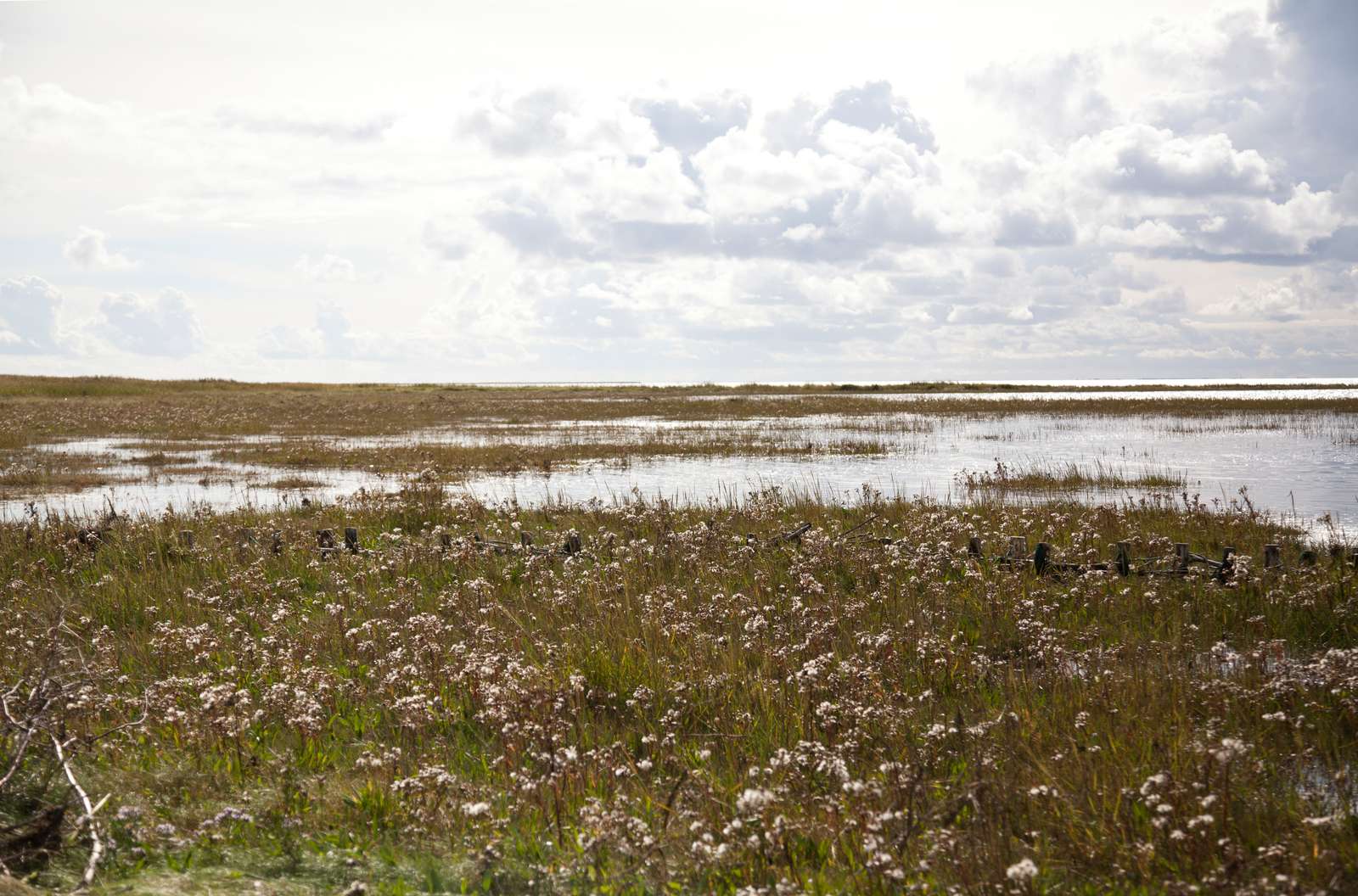

The dikes along the coast of the Danish Wadden Sea, the tidal wetlands along the North Sea
The dikes along the coast of The Wadden Sea have different heights. The Ribe dike has a height of 7.00 meter (23 feet) and the forward Dike at Højer 7.45 meter (24,5 feet).
In the aftermath of every large storm a public debate regarding the dikes follows – and for good reasons.
The local community will invariably discuss whether the dikes are strong enough, high enough.
Nowadays, when repairing the dikes, they are simultaneously being remodelled. Several of the old dikes have in this way been reinforced by flattening their profile facing the North Sea. During a storm the waves will then lose some of their speed and power on their way up the dike. If the dike is too steep the waves can more easily make holes in the surface, and in the end break through it. All the newer dikes are broad and have a slight fall at the side facing the sea.
Does all this sound overly technical? Well, living in a low-lying coastal region spurs one’s interest in such technical details. For instance: In terms of the architecture of the dikes and the aforementioned slight fall, it seems equally important to have a stable core of sand inside the dike. In this way a sufficient drainage is achieved too. The Ribe Dike is provided with such a core of sand. But some of the older dikes were built with a mixture of different soils, which doesn’t give the same proper drainage. Under construction the kernel of sand is covered with a thick layer of clay – ½ to 1 meter. The clay is dug out behind the dike, so that a ditch runs along the dike providing further safety.
Storm surge
A storm surge is defined when the sea presses against the dikes and reaches a level of more than 2.40 meter (7,9 feet) above normal levels in Denmark (DNN). At that point the shore lands will be flooded and fauna and flora are endangered.
When the sea level reaches 4.00 meter (13,1 feet) above DNN the flooding threatens the lowest dike at Ballum and both buildings and humans will then be in danger.
We recommend that you visit the Wadden Sea Centre to see their storm surge show. Read about the Wadden Sea Centre: Museums and Activity Centres
Read about the Danish Wadden Sea National Park : The Wadwden Sea, Denmark
You can rent a bike and cycle to the dike: Bicycle Rental
| 11 | Oktober | 1634 | 6,01 meter |
|---|---|---|---|
| 03 | December | 1999 | 5,50 meter |
| 27 | November | 1825 | 5,33 meter |
| 24 | November | 1981 | 5,01 meter |
| 03 | Januar | 1976 | 4,70 meter |
| 26 | Januar | 1990 | 4,53 meter |
| 23 | November | 1928 | 4,50 meter |
| 27 | Oktober | 1936 | 4,50 meter |
| 05 | November | 1911 | 4,40 meter |
| 15 | Januar | 1968 | 4,22 meter |